Research Foundations of Modal Analysis and Load Test Methodology
A source-led history of structural dynamic research and how it led to the development of STRAAM techniques and technology.
Why Modal Analysis Matters
Modal analysis has been a cornerstone of aviation and automotive engineering for over five decades. By analyzing vibrational response and deriving modal properties, these industries identify destructive resonance and fatigue points early in the life cycle—mitigating structural risk, extending asset longevity, and supporting industry safety standards.
While modal analysis is a well-established discipline in aerospace and automotive design, its application to civil infrastructure requires specialized expertise. Most undergraduate engineering programs offer minimal exposure to structural dynamics, reserving the topic for master’s and doctoral studies. Consequently, many structural engineers face a gap in practical experience when applying these advanced diagnostic tools to aging infrastructure.
STRAAM aims to help advance the industry by bridging this gap and giving structural engineers the knowledge and skills to quantify structural capacity and behavior accurately. These assessments can support improved safety, code compliance, and longer service life. Understanding the history of dynamic analysis is essential to understanding its value.
How Full-Scale Testing Measures Structural Response
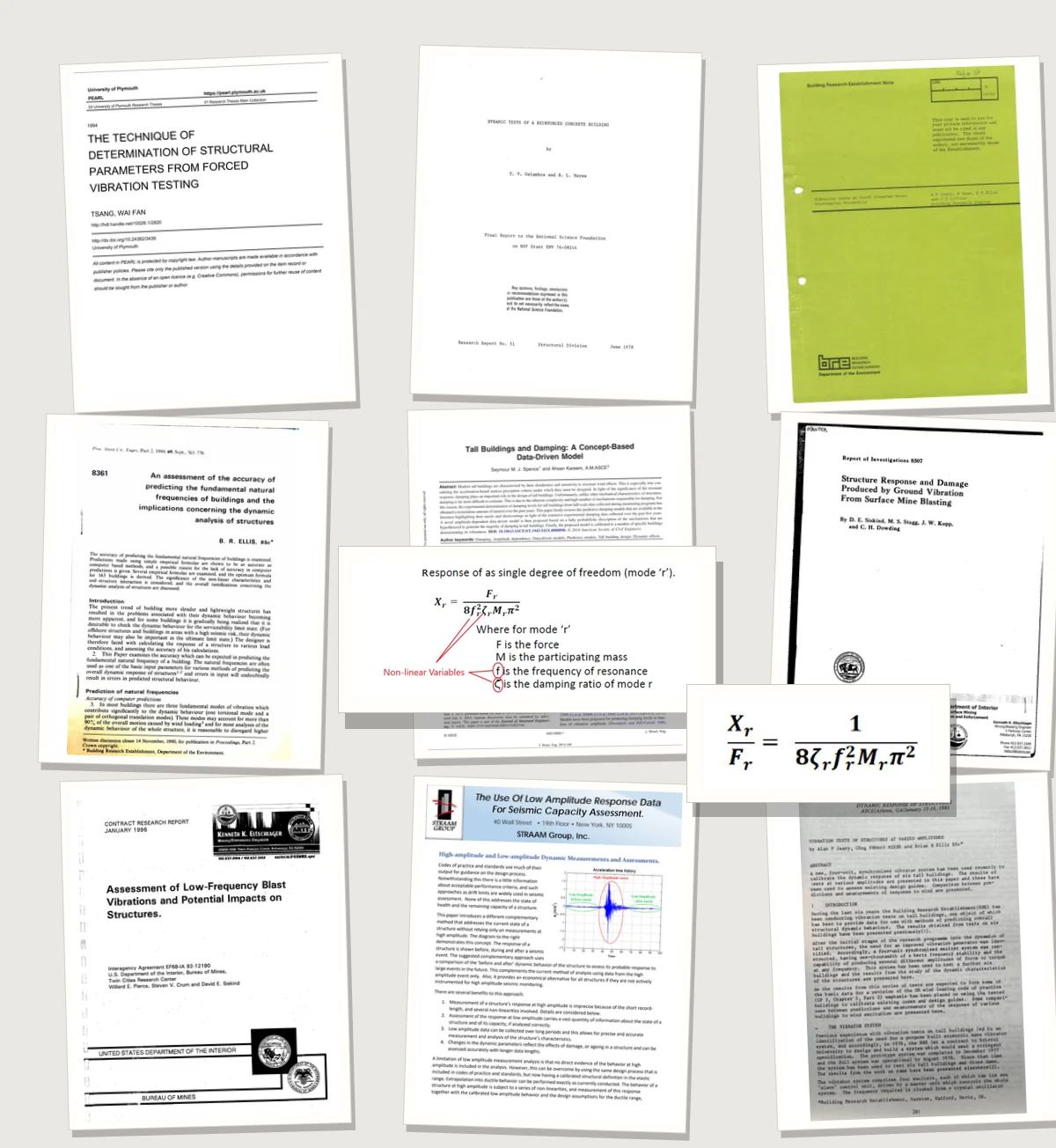
Researchers around the world have spent decades quantifying how structures behave under wind and seismic events. The greatest advances came from studies of full-scale structures. Chapter 2 of the referenced PhD thesis, “The Technique of Determination of Structural Parameters from Forced Vibration Testing,” identifies notable authors and institutions that conducted significant research before the thesis was published in 1994. Understanding the scale of this work is important: it substantially advanced the building sciences and helped code committees make decisions based on sound engineering principles. That work, in turn, supported improvements to the design process and helped make buildings safer over time.
Buildings, bridges, and other structures were measured under both induced forces (EMA) and natural forces from wind and earthquakes (I-OMA). Induced-vibration tests provided the most controlled conditions for observing how structures responded to force. The research applied structural-dynamics principles to explain why structures responded as they did and to establish a practical roadmap for measuring the response of different structures. Applying these principles requires measuring a structure’s modal properties. The process includes:
- Identifying the modes of vibration to be tested.
- Applying force to the structure and measuring its response.
- Determining the frequency and damping responses inherent in the structural system.
- Determining how the structure moves at different locations in each mode of vibration; these patterns are known as mode shapes.
- Determining the structure’s displacement-per-unit-force relationship, which represents its capacity.
These principles underpin the studies referenced here and are among the most important characteristics governing structural performance. EMA and I-OMA were used for decades to analyze structural response to forces, although these methods can be time-consuming, impractical, and expensive.
The Four Modal Analysis Approaches
The following overview describes four major research approaches used to load-test buildings and assess structural response. For decades, modal-analysis techniques have helped researchers understand building response and structural performance and have informed building codes across the United States. PhD researchers in structural dynamics in the United States, Europe, Asia, and elsewhere have conducted this work. Across these research programs, dynamic analysis uses four basic methods to collect structural data for modal analysis.
- Input-Output Modal Analysis (I-OMA). Earthquake or strong-wind monitoring, including California’s Strong Motion Program, is an example of this approach. The U.S. Bureau of Mines’ RI 8507 and many other research and code documents also draw on it. A force or forces must occur to produce a response. As a strong-motion approach, it focuses on high-amplitude measurements during earthquakes.
- Experimental Modal Analysis (EMA). This method applies a known force or mechanical vibration at a specific frequency to produce a modal response. It is a controlled methodology that has been used for decades. STRAAM’s Dr. Alan Jeary, PhD, conducted the largest body of forced-vibration tests ever performed on full-scale structures, during the 1970s and 1980s. One of his papers is included below. The tests excited specific resonances to clarify structural response as a single-degree-of-freedom system. This method uses higher-amplitude signals generated by controlled mechanical forces.
- Operational (Output-Only) Modal Analysis (OMA). This method monitors bridges or buildings under operational forces. Used for decades, it captures responses to regularly occurring forces such as traffic, wind, and waves. Although often described as ambient excitation, it resembles I-OMA because the input force can significantly influence the output response and introduce error into an analysis of the structure’s dynamic characteristics.
- Operational Modal Analysis Using “White Noise” (White-Noise OMA). This method captures structural response to random ambient excitation and applies spectral analysis using band-limited white noise. It is a lesser-known but rapidly growing field that measures very low-amplitude vibrations caused by background ambient “white noise.” Effective use requires specialized equipment, data-management capabilities, and experience. White-noise OMA provides data efficiently and accurately because isolated large-force events do not distort the response measurements. When modal analysis and monitoring use white-noise methods, the system can also capture high-amplitude behavior addressed by I-OMA and OMA. This approach allows a structure’s dynamic performance to be characterized in hours, compared with the weeks or months required by other methods. Changes in the measured parameters can support damage detection because they are captured in an accurate form.
Galambos and Mayes
The aforementioned PhD thesis references a 1978 paper by T.V. Galambos and R.L. Mayes titled, “Dynamic Tests of a Reinforced Concrete Building,” describing a forced-vibration test commissioned by the National Science Foundation. The researchers tested an existing structure by applying forces well beyond its elastic limit, intentionally initiating damage so they could measure changes in its dynamic characteristics and response profile. The test cost approximately $400,000 in 1978. Because the building was already scheduled for demolition, it was torn down after the work was complete. The test therefore produced valuable information but could not be applied to a building that needed to remain in service. The study also verified several fundamental principles:
- Under ambient conditions, the study measured the structure’s modal properties, including resonant frequencies, damping, and mode shapes. These properties represent characteristics related to structural capacity.
- The frequencies of various vibration modes decreased at higher amplitudes and as damage developed.
- At the highest amplitude, the maximum damping response was approximately 4%; it also changed as damage developed.
- Damage began in areas with the greatest modal displacements, as indicated by the mode shapes.
BRE: Building Research Establishment
The thesis also identifies a significant program of forced-vibration research carried out in the United Kingdom by the Building Research Establishment (BRE). The program tested 40 full-scale structures and was the largest program of forced-vibration tests on full-scale structures ever conducted worldwide. It used the most advanced forced-vibrator system available, enabling controlled tests that the source describes as the most controlled conducted before or since. The program is widely regarded as the “gold standard” for forced-vibration testing. Each test is estimated to have cost $200,000 per structure and required several weeks of work by a full team of scientists.
The applied forces remained well below the structures’ elastic limits, allowing the buildings to remain in service after testing. Members of the team received the Telford Gold Medal for induced-vibration tests on dams in four main categories. The medal is the highest award in civil engineering and recognized the tests’ impact and the applicability of their findings to building science; references for the dam research are not included here. Although full-scale vibration tests can be conducted on existing buildings, organizing them is complex, they are time-consuming and very expensive, and they can be mildly destructive. For these reasons, they are generally not used in industry.
The report on the South Stoneham Building in southern England, titled “Vibration tests at South Stoneham House, Southampton University” is consistent with the findings of many other BRE tests. It describes several critical aspects of structural response that are now referenced in ASCE 7.
- The test method followed structural-dynamics principles and identified the structure’s modal properties, including resonant frequencies, damping, and mode shapes.
- The team used a forced-vibrator system to shake the building at resonance, with a frequency precision of 0.001 Hz. The applied force was then stopped abruptly so the structural response could “decay.” This highly precise procedure reduced measurement error and helped reveal the structure’s true behavior.
- The decay in frequency response and damping showed clear nonlinear characteristics. The method’s precision made this nonlinear behavior predictable. At every movement amplitude, using the frequency and damping response in the equation of motion yielded a constant modal mass. Before this work, nonlinear behavior was poorly understood, and estimates were used.
- Repeated trials showed that this nonlinear response was consistent and repeatable. The structure remained “linear elastic” throughout the process, yet the material matrix produced nonlinear behavior. Fracture mechanics explains this response and provides a sound principle for a phenomenon that had previously been poorly understood.
- Because ground-level measurements showed no movement, the researchers concluded that the nonlinear damping response came from the structure’s matrix, with no energy dissipated through the soil. This clarified “structural damping” as one component of “total damping.” Total damping includes the contribution of the ground, internal energy dissipation, and damping within the structure’s matrix. Total damping is generally reported from a structure’s response during seismic activity and can appear highly unpredictable because several mechanisms contribute to it. In seismic monitoring, estimating total damping is appropriate because the purpose is to predict structural displacement, and damping is relevant to those displacement calculations. Isolating structural damping, however, provides a structure-specific parameter associated with capacity and damage, as demonstrated by Galambos and Mayes. Structural damping is nearly impossible to extract from measurements taken during high-amplitude seismic motion, when other sources of damping also play a significant role.
A 1980 BRE paper by Brian Ellis, “An assessment of the accuracy of predicting the fundamental natural frequency of buildings and the implications concerning the dynamic analysis of structures,” reviewed measurements of the dynamic characteristics of 163 buildings. The structures came from the United States, United Kingdom, Canada, and other locations, represented various construction types, and ranged from 10 to 200 meters in height.
The study reported substantial variation in buildings’ natural frequencies, noting differences of ±50% from standard predictors. This finding is significant because a structure’s response to forces varies with its stiffness, which is proportional to natural frequency. The paper cautioned that dynamic models using incorrect estimates could significantly underestimate structural response. It also noted nonlinear behavior in both frequency and damping, and reductions in natural frequency after seismic events that were attributed to structural damage.
The study’s best-fit estimate for a building’s fundamental natural frequency was 46/H, where H is height in meters, equivalent to 150/H when height is in feet. This is the only estimate for the natural fundamental frequency of existing buildings offered in ASCE 7. The study also provided estimates for the orthogonal mode and torsion.
BRE’s work also contributed to understanding structural response, particularly nonlinear damping. Earlier response measurements during seismic events had shown damping to be highly variable and unpredictable, leading to the belief in parts of the seismic community that damping could not be measured accurately. Controlled BRE forced-vibration testing demonstrated the nonlinear nature of structural damping and its predictability. This knowledge was shared with researchers in several countries.
Many research groups followed up with additional testing and developed predictors for nonlinear structural damping. Seymore Spence and Ahsan Kareem of the University of Notre Dame produced an ASCE James R. Croes Award-winning 2013 paper titled “Tall Buildings and Damping: A Concept-Based Data-Driven Model.” The authors summarize historical research and identify a mechanism for nonlinear structural damping. The paper identifies three major damping predictors based on particular populations of structures in different regions of the world, which may contribute to variation, while noting that the predictors are generally similar. The paper is referenced in ASCE 7.
U.S. Bureau of Mines & OSMRE Studies
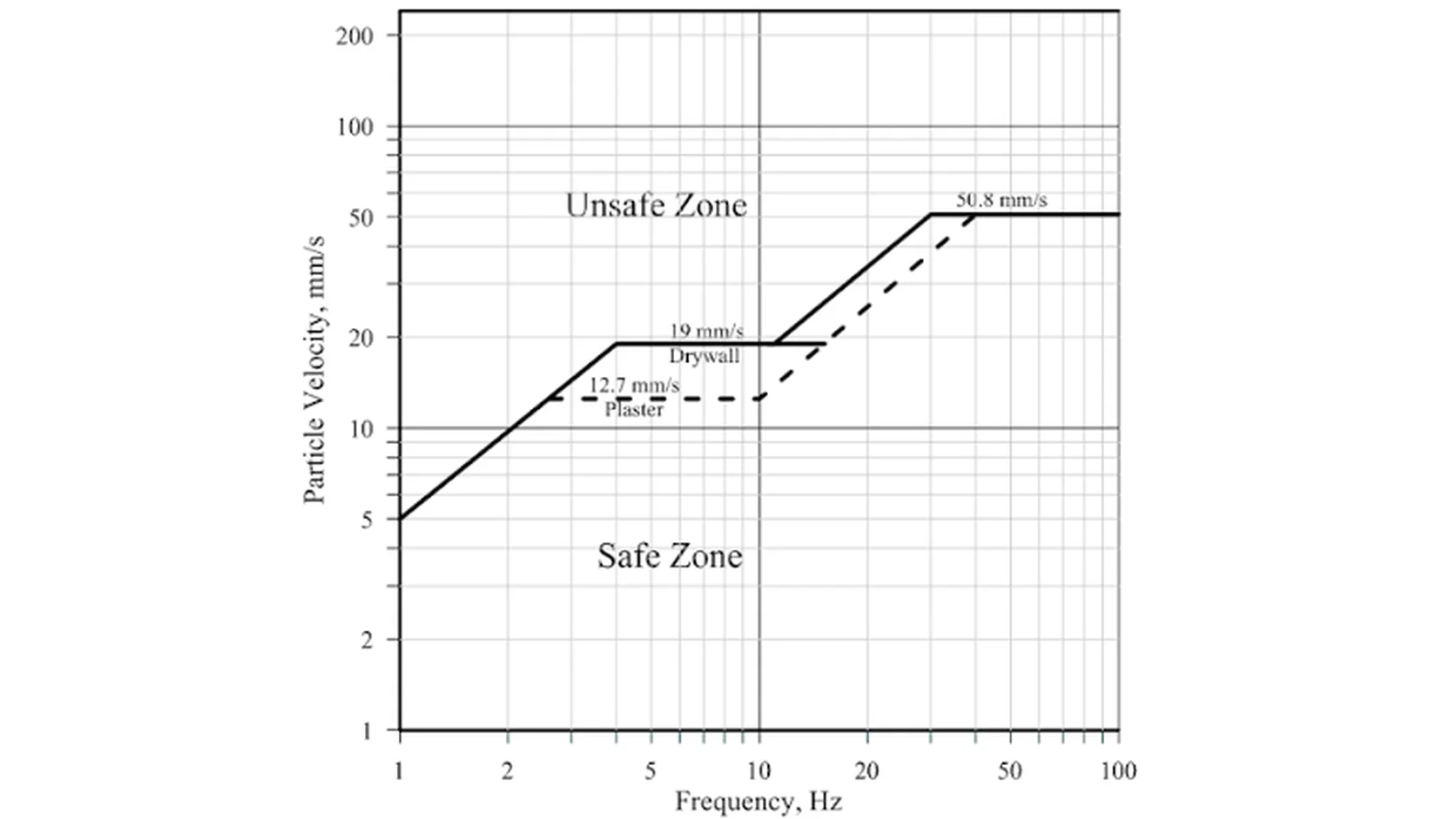
In 1980, the U.S. Bureau of Mines published RI 8507, titled “Structure Response and Damage Produced by Ground Vibrations from Surface Mine Blasting.” The study aimed to explain structural response and mechanisms of damage caused by coal-blasting vibrations. Researchers took dynamic measurements of 79 one and two-story houses and measured the first mode’s frequency and damping response to blasting, following standard dynamic-analysis practice. They used those measurements to estimate displacement and later suggest safe levels of structural response.
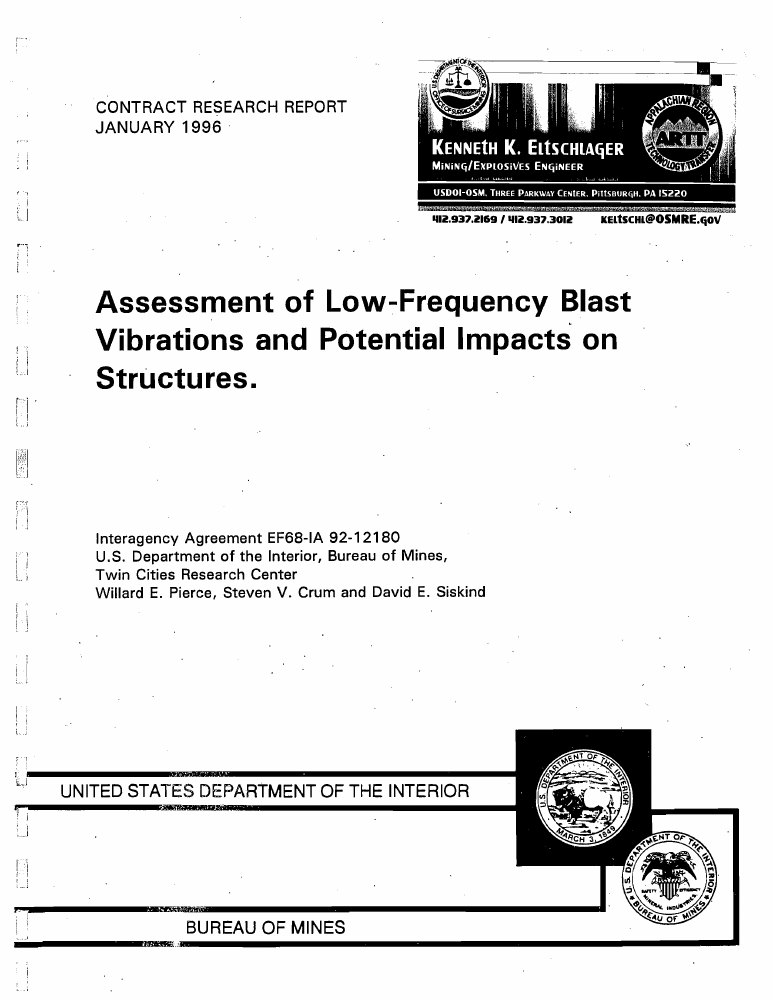
In 1996, the Office of Surface Mining Reclamation and Enforcement (OSMRE) conducted a study titled “Assessment of Low Frequency Blast Vibrations and Potential Impacts on Structures.” It examined dynamic amplification of ground vibrations when their frequency aligns with a structure’s natural frequency. This complemented RI 8507 by examining the potential risk from dynamic amplification.
Response measurements in both documents were not highly accurate, largely because blasting is short in duration, blast energy is random, and structural modal coupling occurs. Appendix B of RI 8507 provides a simplified method for estimating peak particle velocity from ground vibrations and sets threshold limits still used today, often beyond the study’s original scope. The study cautions that the simplified ground-vibration method can introduce additional risks and potential causes of damage.
RI 8507 recommends “spectral techniques,” which it identifies as superior to the Appendix B criteria. However, the study recognized that, in 1980, available technology was less sophisticated than today’s equipment and spectral methods would be cumbersome, expensive, and difficult to regulate. Appendix B criteria continue to be widely used for vibration-intensity alarms. The referenced spectral methods can provide a better understanding of actual structural response and help quantify the critical risk factors identified in the study.
Research Since the 1990s
Funding constraints have limited forced-vibration testing on full-scale structures since the 1990s. Researchers have instead used naturally occurring vibration sources with Operational Modal Analysis or smaller, less expensive vibrators to assess footbridges and floors. Smaller structures and floor systems can be tested with smaller vibrators because their natural frequencies are higher.
Only a small number of induced-vibration tests using vibrators have been conducted since the 1990s, such as:
- Soyoz, S., Taciroglu, E., Orakcal, K., Nigbor, R., Skolnik, D., Lus, H., & Safak, E. (2013). "Ambient and Forced Vibration Testing of a Reinforced Concrete Building before and after Its Seismic Retrofitting." Journal of Structural Engineering, ASCE, 139(10). DOI: 10.1061/(ASCE)ST.1943-541X.0000568.
- Morassi, A. (2011). "Dynamic Testing and Structural Identification of the Hypo Bank Office Complex. I: Experiments." Journal of Structural Engineering, ASCE, 137(12), 1511–1522.
Controlled vibrator tests on smaller structures have been conducted in Japan by Yukio Tamura and in Turkey by Serdar Soyoz and colleagues; these tests have not been repeated.
Research and industry have increasingly focused on Operational Modal Analysis because it offers an efficient way to obtain information about a structure. OMA with white-noise excitation is the best and most repeatable approach for measuring dynamic characteristics and changes in them.
At the 10th biennial EVACES conference, held in Milan, Italy, from August 30 to September 1, 2023, the focus included Operational Modal Analysis using white-noise methods. More than 200 PhDs from 39 countries attended, and 182 papers on the topic were submitted. The group’s stated goal was to advance this technology for assessing and monitoring civil structures. Keynote speakers made the following points:
- These methods are mature and can be applied in industry.
- These methods can be used to quantify damage.
- These methods are efficient and can be applied quickly.
Modal-analysis methods are consistent and represent a valid way to load-test a structure’s response. Applying white-noise methods provides efficient, accurate results and produces a unique signature of the structure for future comparison.
Dynamic Response of Structures Database
Over the past 30 years, a body of work has produced a database of full-scale structural behavior that dwarfs other databases. Ahsan Kareem of the University of Notre Dame in the United States and Yukio Tamura of Tokyo Polytechnic University in Japan produced it with the Center for Excellence of Wind Engineering. The www.vortexwinds.org website provides public access to data on approximately 1,000 structures, including modal frequency of resonance and damping. ASCE 7 references this database.
Standards for Structural Assessment
The International Organization for Standardization published ISO 4866 as a standard for using vibrational response to evaluate structural behavior.
The U.S. government’s National Institute of Standards and Testing also published numerous studies intended to demonstrate the value of dynamic assessments.
Implications for Building Owners and Engineers
Following recent building collapses, legal action has been taken against engineers, owners, and building officials for negligence. Negligent parties found liable face devastating consequences. Some significant points to consider include:
- Building codes (such as ASCE 7 and the IBC) and emerging municipal mandates (like Florida’s SB 4-D milestone inspections) increasingly require owners and engineers to verify structural capacity under real-world loads.
- Building officials are authorized under codes to require an in-situ load test when they consider it necessary.
- An in-situ load test verifies overall building capacity and can identify localized structural weaknesses.
- Engineers relying only on visual inspections face the challenge of verifying that concealed structural members are performing acceptably.
- Engineering ethics require assumptions to be verified. Failure to verify capacity and exercise this legal authority can create devastating personal, professional, and legal exposure.
- An in-situ load test protects building owners, residents, engineers, building officials, and government entities from enormous liability.
STRAAM Dynamic Assessment and Monitoring Technology
STRAAM Group has developed an integrated IoT hardware and analytics platform for dynamic assessments based on established research practices from the past 50 years, without requiring a large, expensive vibrator system. The platform applies mature principles of Operational Modal Analysis using white noise as the energy source, allowing STRAAM to capture data and apply appropriate analysis techniques.
A critical part of the analysis is examining the data, including its nonlinearities. All structures behave nonlinearly, and ignoring this behavior limits the value of modal analysis. These advanced skills make STRAAM unique in the industry. Accurate structural-response assessment requires:
- Determining the modes of vibration and mode shapes.
- Quantifying the frequency response in each mode in nonlinear form, as far as possible.
- Quantifying the damping response in nonlinear form, as far as possible.
The research shows that a structure’s dynamic parameters directly affect its response to forces. The cited papers provide ranges for these parameters that can help estimate how well-performing structures behave. They also show that weaknesses in some buildings are reflected in changes to these parameters. Reduced stiffness, which is directly proportional to frequency response, is associated with damage or aging. Increased damping is also associated with damage.
The research established an empirical basis for understanding how structures respond to imposed forces. BRE documented the nonlinear response of frequency and damping. It also showed that Newton’s Second Law of Motion—the foundational principle of structural dynamics—applies consistently across the full amplitude range. For a specific vibration mode, displacement Xr is determined by the applied force Fr divided by constants; for an existing structure, modal mass Mr is generally constant. The two measured dynamic parameters are resonance frequency and associated damping.
The displacement-per-unit-force relationship therefore represents how a structure deforms under loading, based on its dynamic parameters. A conventional load test generally applies a known load and measures a specific response, producing a single displacement-per-unit-force relationship. Research shows that a building’s displacement changes across a range of amplitudes. Accurately measured dynamic parameters can therefore provide additional insight into a specific structure’s behavior and nonlinear response. The result is a representative load test of the structure’s capacity.
Dr. Alan Peter Jeary, one of STRAAM’s founders, led the Dynamics Group at BRE during this research. He oversaw the forced-vibration tests and other research there for nearly two decades. His insight and experience are embedded in STRAAM’s dynamic-analysis platform.
The research also found that, at high amplitudes—for example, under strong wind or seismic forces—dynamic parameters are less consistent for several reasons. Structural response is nonlinear, affecting measurements of parameters treated as linear at the design stage. Researchers reported this variability, which led to speculation that dynamic parameters could not be measured accurately. The controlled research described here demonstrates that they can be measured accurately.
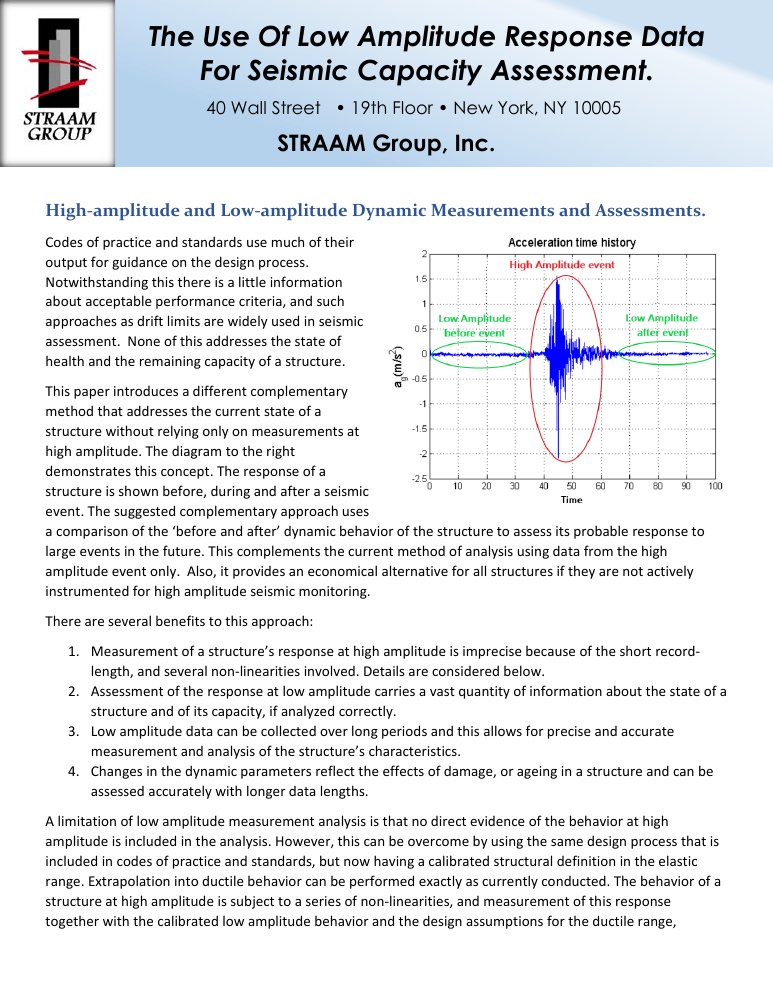
Over the past two decades, sensor technology has become more sensitive and computer processing power has increased, enabling large amounts of data to be managed quickly. Cellular and internet transmission also allow data to be transferred immediately so that a structure’s response can be processed in real time. Because dynamic parameters can be measured accurately across a range of amplitudes and show predictable nonlinear behavior, measurements at the lower end of the amplitude range are also meaningful. Advances in technology now allow structural response to be measured under normal ambient conditions. A STRAAM paper explains the value of low-amplitude measurements compared with high-amplitude measurements.
Conclusion
When appropriate methods are applied under ambient conditions, they provide the opportunity to measure dynamic parameters with:
- Sufficient energy to measure structural response accurately.
- No need to add mechanical excitation to induce a response, reducing costs.
- Unlimited data that allow quality-assurance and quality-control protocols for statistical validity.
- Sufficient dynamic range to capture nonlinear behavior.
- An accurate signature of all vibration modes in the structure.
- A cost-effective, quick test for all structures.
- Measured response that can be compared with code requirements to assess capacity.
Visual inspections alone cannot reveal how a building performs under stress. Backed by 50 years of research, dynamic testing using Operational Modal Analysis (OMA) and forced excitation delivers the empirical data needed to verify structural capacity, track damage over time, and satisfy evolving compliance mandates. By capturing real-time dynamic parameters under operational conditions, with equipment that also supports high-amplitude displacement analysis, asset owners can complement physical inspections, reduce liability, and clarify structural risk to protect public safety.
Bibliography
Ashkinadze, G. A., Zacharow, W., and Sinon, J. (1975). “Investigation nonlinear behaviour of carcassless buildings with powerful vibration generators.” Proc., 5th European Conference on Earthquake Engineering, Istanbul.
Benfer, N. A., and Coffman, J. L., eds. (1973). San Fernando, California, earthquake of February 9, 1971. U.S. Department of Commerce, Washington, DC.
Blume, J., and Binder, J. (1960). “Periods of a modern multi-storey office building during construction.” Proc., 2nd World Conference on Earthquake Engineering, Vol. 2, 1195–1205.
Briceño, F., Espinoza, A. F., and Arcia, J. (1973). “Dynamic response study of the Palace Corvin building in Caracas, Venezuela.” Proc., 5th World Conference on Earthquake Engineering, Vol. 1, 274–285.
Buller, P. S. J. (1978). Wind damage to buildings in the United Kingdom, 1970–1976. Building Research Establishment Current Paper CP 42/78.
Burrough, H. L., Kinloch, H., and Winney, P. E. (1970). “Vibration studies on full-scale structures.” Proc., SECED Conference on Dynamic Waves in Civil Engineering, University College Swansea, Swansea, U.K.
Cano, J. H. (1977). “Guatemala earthquake of February 4, 1976: Description and analysis of damages caused on buildings.” Proc., 6th World Conference on Earthquake Engineering, New Delhi, India, 299–303.
Chen, C. K., Czarnecki, R. M., and Scholl, R. E. (1977). “Vibration tests of a four-storey concrete structure.” Proc., 6th World Conference on Earthquake Engineering, New Delhi, India.
Cherry, D. E., and Brady, A. G. (1965). “Determination of structural dynamic properties by statistical analysis of random vibrations.” Proc., 3rd World Conference on Earthquake Engineering.
Coyle, D. C. (1931). “Measuring the behaviour of tall buildings.” Engineering News-Record, Feb. 19.
Crawford, R., and Ward, H. S. (1964). “Determination of the natural periods of buildings.” Bulletin of the Seismological Society of America, 54(6A), 1743–1756.
Del Valle, E., and Prince, J. (1965). “Analytical and experimental studies of vibration in two buildings.” Proc., 3rd World Conference on Earthquake Engineering, Auckland, New Zealand, Vol. 2, 648.
Ellis, B. R. (1979). “A study of dynamic soil–structure interaction.” Proceedings of the Institution of Civil Engineers, Part 2, 67, 771–783.
Ellis, B. R. (1980). “An assessment of the accuracy of predicting the fundamental natural frequencies of buildings and the implications concerning the dynamic analysis of structures.” Proceedings of the Institution of Civil Engineers, 69(3), 763–776. https://doi.org/10.1680/iicep.1980.2376
Ellis, B. R., and Littler, J. D. (1988). “Dynamic response of nine similar tower blocks.” Journal of Wind Engineering and Industrial Aerodynamics, 28(1–3), 339–349. https://doi.org/10.1016/0167-6105(88)90130-4
More from the archive
Keep exploring the evidence.
Browse all insights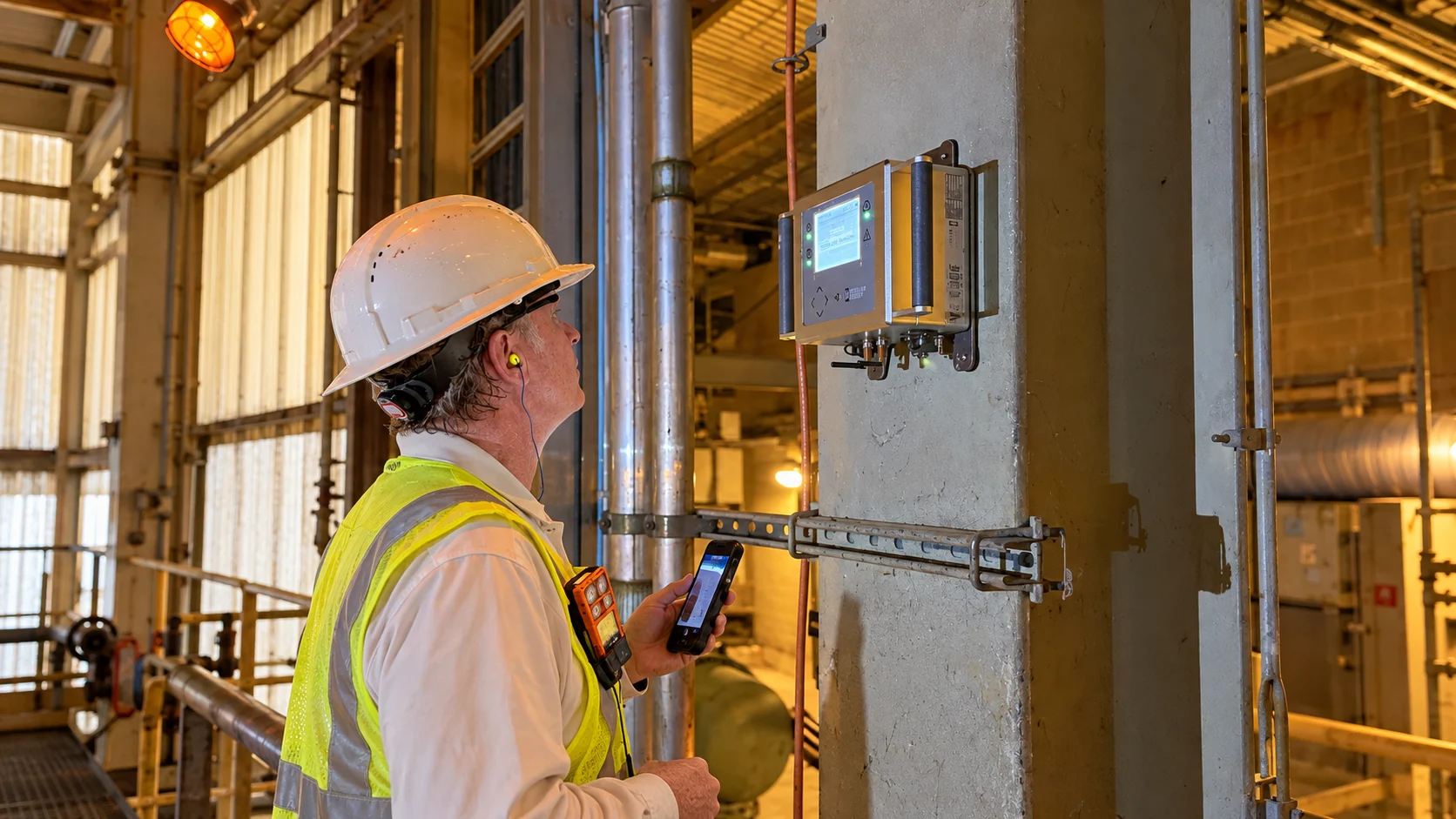
Baseline Dynamic Signatures: A Reference for Continuous Monitoring
A baseline dynamic signature records how a structure responds before monitoring begins. Repeated measurements can then help engineers identify changes that warrant investigation.
Read insight